

 Spotify
 Apple Podcasts
 YouTube
 iHeartRadio
 How 'No One Died: The Wing Bowl Story' Was Made for Streaming | Pat Taggart, Director
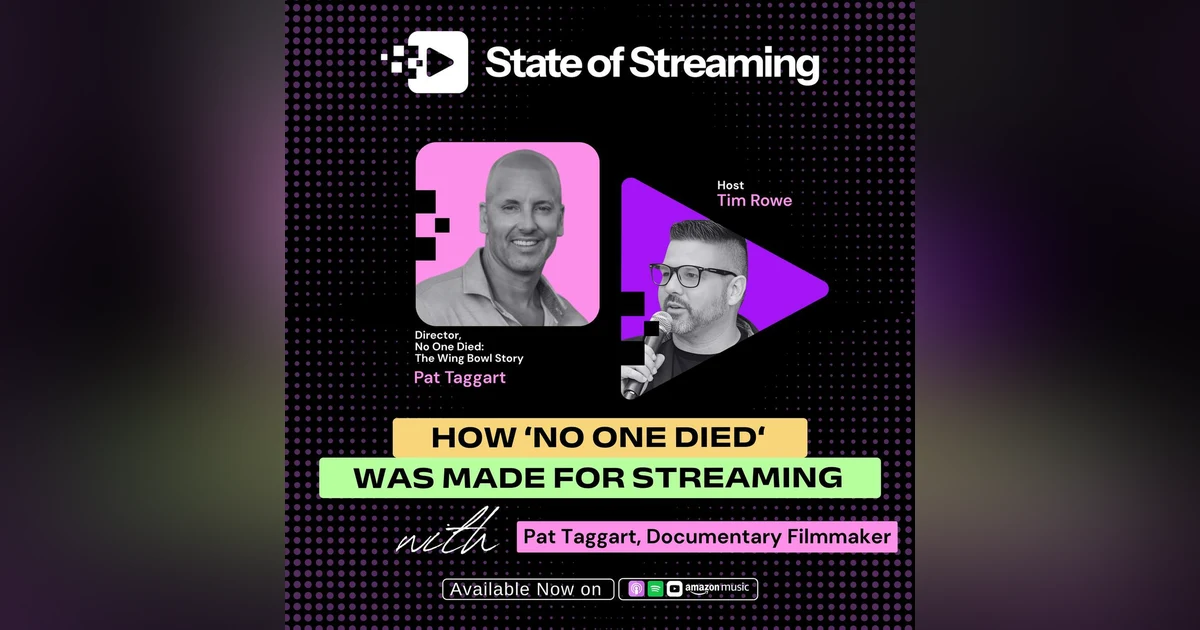

Have a question? Send us a text! Tim sits down with Pat Taggart, filmmaker and founder of Sky Blue Creative, to discuss his new documentary No One Died: The Wing Bowl Story — the 26-year history of Philadelphia's most chaotic winter tradition, and what self-distributing an independent film in today's streaming market actually looks like when the major players come calling with contracts designed to take everything. A radio joke in 1993. 30,000 people in an arena by the end. Al Morganti ...
Key Takeaways
- Filmmaker Pat Taggart joined the podcast to discuss his new documentary, 'No One Died: The Wing Bowl Story,' which chronicles the 26-year history of Philadelphia's chaotic winter tradition.
- The documentary highlights how a 1993 morning radio show joke between Angelo Cataldi and Al Morganti evolved from a folding table at a Ritz-Carlton hotel into a packed arena spectacle with 30,000 attendees.
- Pat Taggart turned down major production company acquisition offers because the contracts demanded stripping him and his producer of creative control, financial attachment, and directorial credit.
- By bypassing traditional distributors and using an aggregator for self-distribution, Pat was able to release the film on Prime Video, Apple TV, and YouTube while retaining complete creative ownership.
- The indie streaming landscape has shifted dramatically since COVID-19, with major streaming platforms slashing acquisition offers for independent documentaries from seven figures down to $30,000.
Have a question? Send us a text!
Tim sits down with Pat Taggart, filmmaker and founder of Sky Blue Creative, to discuss his new documentary No One Died: The Wing Bowl Story — the 26-year history of Philadelphia's most chaotic winter tradition, and what self-distributing an independent film in today's streaming market actually looks like when the major players come calling with contracts designed to take everything.
A radio joke in 1993. 30,000 people in an arena by the end.
Al Morganti threw out a throwaway comment on the air — the Eagles are never going to the Super Bowl, let's have a chicken wing-eating contest instead. Two guys at a folding table in the lobby of a Ritz-Carlton-caliber hotel. Two hundred drunk Philadelphians showed up. The hotel told them never to come back. The next year, 700 people showed up in an ice storm to watch year two at Mike Schmidt's bar on Market Street. It grew from there.
- 3:01 – How a passing comment on Philadelphia sports talk radio became a 26-year tradition
- 4:15 – Year one: a folding table at a hotel, 200 hooligans, and a horrified management team
- 5:39 – What the Florida Film Festival reviewer called "strangely heartfelt" — and why they were right
For 364 days a year, the participants were anonymous.
For one day, 30,000 people knew their name.
Landscapers, security guards, plumbers, mailmen. Wing Bowl gave regular people a moment that almost nobody gets — walking into a packed arena with 30,000 people on their feet screaming for them. The community that formed around it was a brotherhood and sisterhood that reunited every year. The chaos on the surface was real. So was everything underneath it.
- 5:54 – Why Wing Bowl was as much about community as it was about spectacle
- 6:46 – How Pat approached the tonal shift from harmless joke to massive cultural event
- 17:41 – The universal story: the little guy getting their shine, freedom of expression, a runaway train
A truck exploded in the parking lot. A man was attacked by dogs carrying grilled cheese. Someone ate three candles.
The behind-the-scenes stories that didn't make the final cut are as good as the ones that did. Mitch Williams — the relief pitcher famous for giving up the World Series-winning home run to Joe Carter — parked his truck over smoldering tailgate embers and it blew up. A Wing Bowl qualifier was attacked by stray dogs on his walk to the studio because they smelled the grilled cheese in his backpack. One contestant's qualifying stunt was eating actual wax candles. Pat had 40 characters in the film and says he could have made another film with 100 more.
- 14:59 – The Mitch Williams truck explosion story that didn't make the cut
- 15:30 – The grilled cheese dog attack that almost got a guy disqualified
- 16:10 – The candle eater and the philosophy of finding the best collection of characters possible
Two of the largest production companies on the planet made offers. Pat walked away from both.
During COVID, major streamers were buying documentaries at massive multiples — seven figures for content that wasn't even exceptional, just available. The pendulum has swung hard in the other direction: $300,000 documentaries now selling for $30,000 because filmmakers have no leverage. Two major production companies approached Pat about Wing Bowl. Their contracts would have removed Pat as director, removed the producer, severed all financial and name attachment, and given them full narrative control. Pat said take it out of the contract. They said that's not our intention. He walked.
- 19:23 – Why the major streamers are now buying $300K documentaries for $30K
- 19:48 – What the production company contracts actually said — and why Pat walked
- 20:30 – The self-distribution decision: aggregator over distributor, creative control over upfront money
Self-distribution is more expensive upfront. It's also the only way to keep the film you made.
Pat went through an aggregator instead of a traditional distributor to get the film on Prime Video, Apple TV, and YouTube. It cost more out of pocket. But the film that's on those platforms is the film he intended to make, and he's still attached to it by name and financially. His wife's cousin asked if it was on Fandango. It isn't. Discoverability in a world of infinite shelves is the next problem — and it's the same problem every content creator faces.
- 18:53 – Why Pat passed on Fandango and chose to stay on three major platforms
- 19:11 – The discoverability problem: you have to be in all the stores, on all the shelves
- 20:30 – What self-distribution via aggregator actually costs and what it protects
Connect with Pat Taggart on LinkedIn · pat@skybluecreative.com · wingbowlmovie.com
Thanks to Looper Insights for sponsoring today’s show! Ready to unlock your streaming strategy edge? Head over to mystreamingvalue.com to compare CTV home screens and find out which spaces are worth the most. You’ll even learn exactly why Fox was willing to pay $22 billion for Roku. Stop guessing and start scaling—visit mystreamingvalue.com to get your free insights today!
Frequently Asked Questions
What is 'No One Died: The Wing Bowl Story' about?
It is a feature-length documentary directed by Pat Taggart that explores the 26-year history of Philadelphia's Wing Bowl, a wildly chaotic annual winter tradition that started as a sports talk radio joke and grew into a massive 30,000-person arena spectacle.
Where can I watch Pat Taggart's documentary 'No One Died: The Wing Bowl Story'?
The documentary is currently available on demand across three major streaming platforms: Prime Video, Apple TV, and YouTube.
Why did filmmaker Pat Taggart choose self-distribution over a major studio deal?
Pat turned down offers from major production companies because their contracts would have stripped him of his directing credit, removed his producer, severed his financial attachment, and taken away all creative control.
00:00 - Two Wild Questions To Start
01:46 - Meet Pat Taggart And Wing Bowl
03:35 - The 1993 Origin Story
06:23 - Community, Characters, And Pageantry
12:55 - Editing Strategy For A Documentary
15:30 - Incredible Stories Left Out
18:07 - The Universal Takeaway Beyond Philly
19:20 - Where To Watch And Get Found
20:32 - Indie Distribution Gets Ugly
22:56 - Contact Info And Final Sendoff
Two Wild Questions To Start
Tim Rowe, Host, State of Streaming Podcast
How did a morning radio show joke in 1993 explode into a 30,000-person-packed arena phenomenon? And why are independent filmmakers turning down major studio deals to self-distribute on streaming platforms? Today, filmmaker Pat Taggart joins the show to discuss his new documentary, No One Died: The Wing Bowl Story. We cover the wild 26-year history of Philadelphia's most chaotic winter tradition and the harsh distribution realities independent creators face in today's streaming market. Hit subscribe so you never miss our behind-the-scenes creator conversations like this. Let's get right into the interview.
Meet Pat Taggart And Wing Bowl
Tim Rowe, Host, State of Streaming Podcast
Not for a game, but for Wing Bowl. Part competitive eating contest, part carnival, part cultural defiance, Wing Bowl was founded in 1993 by local radio hosts born from the frustration of a city whose team couldn't seem to make it to the biggest stage. For the better part of three decades, Wing Bowl was Philadelphia's Super Bowl, a spectacle that was equal parts absurdity and genuine community held together by the city's relentless, hard-edged love of its own. No One Died: The Wing Bowl story captures this phenomenon on film for the first time. It's available on demand on Prime Video, Apple TV, and YouTube. And today I'm with Pat Taggart. Pat, thanks so much for joining the show. Tim, what a setup. Let's do it, man. I'm so grateful to be here. I'm so grateful that you're here. We just kicked off season five with NFL legend Shawne Merriman. Football season is underway. Every great story has great characters. Maybe, maybe we set the stage. Who is Angelo Cataldi?
Speaker
In my world, Angelo Cataldi was the only must-have in telling this story. He was the only yes we needed to move forward. Angelo Cataldi is uh the most, I don't even want to use famous, most iconic voice in Philadelphia sports talk radio. Angelo Cataldi is a Columbia educated journalist who flipped over to sports talk radio. He's an introvert in real life who was the complete opposite of that on the air. He's the guy that breathed life into Wing Bowl, brought excitement, drugged three months of programming out of a four-hour annual event. You cannot talk about the passion of Philadelphia sports and sports talk radio without mentioning Angelo Cataldi.
The 1993 Origin Story
Tim Rowe, Host, State of Streaming Podcast
So Angelo is on air. We're back in 1993. Take us back in time. Where does this idea come from? How does this become a thing?
Speaker
It would have never happened if the Eagles didn't suck as bad as they did. And they sucked. And they sucked. And people look now and they're like, you guys are spoiled. Well, we weren't for a very long time. Angelo Cataldi's on air partner is a guy named Al Morganti, who has been famous for really for hockey. He's a hockey guy first and foremost. And so he would do national games for ESPN. And then during the week, he'd host the morning show with Angelo Cataldi. So they're on the air lamenting about another Super Bowl approaching and the Eagles nowhere near Super Bowl contention. And Al, as a passing comment, says, you know, we should do something on Super Bowl weekend. Make it our own. The Eagles are never going to be in it. Have our own party. And he had been the Buffalo quite a bit recently covering hockey. Love the Buffalo wings at the famous anchor bar. And as a throwaway comment, Tim says, Let's have a chicken wing-eating contest. Billy's known for cheesesteaks, right? He didn't say let's have a cheesesteak contest. Let's have a chicken wing-eating contest. So they did a Friday remote broadcast at the Wyndham Franklin Plaza, which at the time was one of Philadelphia's most, I'd say, upscale hotels.
Tim Rowe, Host, State of Streaming Podcast
Okay, so this was a fancy place. This isn't like a slum dive bar.
Speaker
We're having it at the Think Ritz Carleton. Okay? That's a name that'll ring true to your audience. This is like in a Ritz-Carlton type of hotel. Now picture a folding table with two fat guys eating chicken wings as business people are checking in and out of this hotel. And to the surprise of the radio station, 200 drunk hooligans show up to watch this chicken wing eating contest. Some of them drinking beer out of brown bags in the lobby of this hotel.
Tim Rowe, Host, State of Streaming Podcast
Where did they come from?
Speaker
Listeners, right?
Tim Rowe, Host, State of Streaming Podcast
They're listening, hearing this is going on.
Speaker
This is a live broadcast. And show up. And they show up, much to the surprise of the station and the horror of the Wyndham Franklin Plaza, who said as soon as it concluded, don't ever come back and do this again. They were aghast. They were aghast. And the station never thought they would until next year rolled around. Everybody's like, hey, you should do that again. That was a lot of fun. And they had them back. No, they didn't have them back. But I will also say that their hotel couldn't have accommodated the demand for people to watch at that point. So the next year they went to Mike Schmidt owned a place on Market Street. Mike Schmidt, the famous Philadelphia Phillies third baseman. Year two, 700 people showed up in an ice storm to watch a chicken wing eating contest in the dead of winter.
Community, Characters, And Pageantry
Tim Rowe, Host, State of Streaming Podcast
A reviewer from the Florida Film Festival described it as strangely heartfelt. Behind the beer, the grease, and the chaos. What is the human story? Why was this so captivating?
Speaker
The coolest thing about Wing Bowl was for 364 days, most of the participants were completely anonymous. You have landscapers, security guards, plumbers, mailmen. For one day a year, these people got their shine. They know what it's like to walk out and have 30. We're jumping ahead the story a little bit. They know what it's like to have 30,000 people on their feet screaming for them and knowing their name. These people got an incredible moment in the sun, and they formed like this brotherhood and sisterhood, because it wasn't all guys by any means. There was probably more girls involved than guys, especially towards the end. They looked forward to seeing each other every year. It was an annual party, it was a reunion. There was so much more to this than what people would anticipate on the surface.
Tim Rowe, Host, State of Streaming Podcast
So, as a filmmaker, how do you approach that? How do you approach the shifting tone from this is a harmless joke to this is this massive spectacle with lots of opinions, I'm sure lots of opinions about how it was being pulled off and executed.
Speaker
Yeah, I think the most important thing is you go in without an opinion. And you know, the story exists in the people that experience the event. I was there twice. I was there once when I was a bartender. I was like 21, and I took an old guy, a regular in my bar that loved it, and he he asked if I would drive him. So we went down and watched it. I'm also in the movie for three seconds. I was in what was called an entourage. So all the eaters had to come out with some sort of theme and an entourage. You couldn't just walk out on the stage with it.
Tim Rowe, Host, State of Streaming Podcast
We've got music WWE. It is WWE. We've got El Wingador Sloth, the Black Widow. Like these are these are characters. This is not Joe the Plumber. He is today El Wingador.
Speaker
Nobody used their it because it wasn't that that wasn't the point. It wasn't an it wasn't Nathan's. People in Nathan's use their own name because it's an eating contest. This wasn't an eating contest. This was it was this was a party with oh, by the way, there's people eating chicken wings to see who can eat the most. The contest was relevant for the last two minutes if it was close. The rest of the time, it was just the wildest party that media and potentially this country has ever seen. Let's watch the trailer here.
Speaker 2
Wingball. Let's talk about it. I mean, the easy way to describe it is that it's a wing-eating competition, but nothing that you can find online will ever do it justice. How absolutely outrageous and ridiculous it is. The wing-eating was secondary.
Speaker 4
The whole lead-in to it and the the crowd, the pageantry, the city of Philadelphia decided they were gonna do this every year. On his face was the bullet tree. They were on the front page of the daily news, and that's not anything these guys normally would be on unless they held up a band.
Speaker 3
Somebody you should have stopped us.
Tim Rowe, Host, State of Streaming Podcast
And if you were just listening to that, you might have recognized some voices in there. Jason Kelsey, I saw Ric Flair, Dennis Rodman, Snooky. This was a star-studded event.
Speaker
Yeah, I mean, by you have to think when you carry on as long as this did, 26 years, you have to keep introducing new things. And at some point, somebody said, let's start bringing in celebrities. And Snooki had just gotten punched in the face in an episode of Jersey Shore. So she was the hot thing at the time. And they bring in Snooky. She was actually on one of the late night shows in LA, flew a red eye in. Oh, wow. Really no idea what Wing Bowl was, and she walked out of the tunnel and they introduced her strategically as from New York City. And of course, sports rivalries, right? So she gets mercilessly booed as she comes through the tunnel. But she was awesome. Like she was so cool about all of it. And they had a mechanical bull there, and they said, Snooky, will you get on the bull? And Snooky got on the mechanical bull and won the crowd over, right? Because she was game. And then it became like, who else can we get? And so that's where you get Rodman and Flair and McFoley and several adult entertainers, we'll call them. So like Jenna Jameson was there. Katie Morgan was like a co-host for two years. Like it just it just spiraled completely out of control. Remember, this is a radio station putting on an event for 30,000 people. They don't know how to put on it. They didn't hire an event company, they just kind of figured it out and hope no one died and hope they got through to the end of the broadcast and everything worked.
Tim Rowe, Host, State of Streaming Podcast
All part of it's they were just winging it.
Speaker
They were totally winging it. Yes, there was a run of show, but it never went according to plan. Right? Like, I mean, because it was insanity. You know, like they're trying to do a broadcast and then a brawl might break out on the right hand side. And there's, you know, 150 strippers from the local strip clubs walking around a bikinis or less. What do you do? What do you do? Exactly. All of whom, by the way, fought over who could be there. Like the women loved to be part of this event as much as the guys loved to be there, right? So it was just the day that you had to be a part of. And if you didn't want to be a part of it, by the way, it was easy to miss. It was four hours a year on a Friday morning in the dead of winter. Don't go, don't listen to the radio wing balls over. So totally voluntary.
Tim Rowe, Host, State of Streaming Podcast
It happens like a tree falling in the night.
Speaker
That's it. Yep. Yeah. And then left quite a bit of debris in the parking lot.
Tim Rowe, Host, State of Streaming Podcast
Oh my god, a lot of trees falling in the middle, a hurricane in the middle of the floor. Yes.
Speaker
Tornado. A tornado through a forest. That's what you had.
Editing Strategy For A Documentary
Tim Rowe, Host, State of Streaming Podcast
Pat, from an editing standpoint, this is this is not your first documentary. This is this is part of a portfolio, a career of telling stories. What was your organizational strategy? You're looking at almost three decades of footage here telling this story of crescendo from being at the hotel with 200 people to packing out arenas with 30,000 people. How do you approach that as a storyteller?
Speaker
The thing that I think a lot of people that don't do this work wouldn't understand is that probably the first 80% of editing is not fun. So essentially, my process is this after every interview, I cut down each individual interview, and we did 40 for this movie. After each individual interview, you cut it down to anything that's usable. So, Tim, if I interviewed you and we spoke for an hour, I would cut that down to maybe 20 minutes, right? Cutting out my voice, cutting out, not that you would ramble, of course, but cutting out ramblings, cutting out in our case, things that were too parochial. So when people got too into the weeds of Philly, we kind of got rid of that stuff because we wanted this to be a film that could be enjoyed by people that live here or don't live here, that know Wingbull or don't know Wingbull. So 40 interviews cut down to maybe a third or 25% of what we talked. And then from there, I create what's called buckets. So I'm identifying all the common topics that people talk about, and then I'm finding all the clips from those cut downs and putting them in those buckets. Not until I get to those buckets can I start having fun. At that point, I treat a movie as several short films. So I'm gonna cut those buckets as their own short film. I'm cutting segments. I'm not looking macro, I'm looking micro. So to qualify for Wing Bowl, you had to propose an eating stunt, go into the studio live on the air and perform that. I'm gonna eat 10 Big Macs in 10 minutes. To be accepted as a contestant. Correct. You had to propose an eating stunt. I cut that as its own movie. Everything people said, the archival footage that relates to that was its own short film. Once I have all of those, then I can figure out where do all these short films logically fit to tell a cohesive story. And then of course you have to cut down because first cut's gonna be way longer than anybody's gonna watch. It's gonna be a lot there. Exactly. But that's the only way that I mean, I think everybody has their own style. That's the only way that I know how to do it. Sadly, you can't just record and say, let's tell this story. It doesn't work like that. It's a lot of organization before you get the reward of telling the
Incredible Stories Left Out
Speaker
story.
Tim Rowe, Host, State of Streaming Podcast
What are some scenes? What is some footage that didn't make the final film that maybe you wish it had or or you wish it could see the light of day? Any any favorites that that didn't get to the final edit?
Speaker
Yeah, I'm gonna give you two kind of behind-the-scenes stories that I love. So again, this goes back to not getting to Philly. There was a relief pitcher for the Philadelphia Phillies named Mitch Williams. Mitch Williams is famous for giving up a World Series winning home run to Joe Carter. Great thing to be famous for. Terrible thing to be famous for. Mitch Williams still loved in the city, though. He came to Wingbowl one year to go on air. He's late. He drives his truck into the parking lot and runs inside. He obviously wasn't paying attention to where he parked because people would get to Wingbull at 2 a.m. after the bars closed, never sleep, tailgate through the night, grill. Someone had grilled in the spot where he parked his truck, and there were smoldering embers on the ground where he parked. He gets in the building and finds out shortly thereafter that his truck had blown up in the parking lot. Now it's crazy. It would have required minutes of setup. Who's Mitch Williams? Why is he important to the story? Ultimately, it detracted from the narrative a little bit, but come on, right? Like, what a great story. I hate that we lost that. Another one goes back to what I mentioned about eating stunts to qualify to be an eater. A guy proposed he was going to eat a bunch of grilled cheese sandwiches in a short amount of time. He was a local guy. He would walk to the studio. His time comes and he doesn't show up for his live on-air stunt. So they move on. At the next commercial break, the door bust open. Here's a guy standing in a doorway. He's bleeding. Here he had a backpack full of grilled cheeses and got attacked by dogs, stray dogs on his way to the studio because they smelled the grilled cheese in his backpack. This is the kind of stuff that not just happens sometimes, it happened all the time. One guy's eating stunt was he was going to eat three candles. Candles. Wax, right? Wax. Not food that's meant to look not like one of those like shows is this cake, right? Like actual candles. It just attracted the craziest, wackiest people, and that was the goal. Let's find maybe five people that can really eat, and then let's find the biggest collection of characters that we can source and make people laugh. And that's that's what I love about. I mean, this is a comedy. Through and through it's a comedy.
The Universal Takeaway Beyond Philly
Tim Rowe, Host, State of Streaming Podcast
It's a comedy, it's a human story, it's a global story. So if someone from outside of the Northeast, that someone outside the Philadelphia area watches it, someone who has zero context on Philly sports, what's the universal relatable story that you hope they walk away with?
Speaker
Yeah, little guy getting in shine, freedom of expression is too. This film is very much about freedom of expression. These are people that came out and didn't want to be told what to do or how to act. I think everybody loves to watch a runaway train, right? No One Died: so you know there's not a tragic ending to it, but it was it was a completely out of control event. So if you like stuff like that, or if you just like to laugh, right? Because you hope that you can find a story with one or two cool characters to latch on to. We got so lucky. This this story, not what we did, the story itself of Wingle has hundreds of incredible characters. We might feature about 40. I mean, we were throwing darts at a dartboard. We could have had 40 more, 60 more, 100 more, you know, like there was no shortage of incredibly compelling, funny, wacky people that we could have featured in this thing.
Where To Watch And Get Found
Tim Rowe, Host, State of Streaming Podcast
Amazing. No One Died: The Wing Bowl story. It's available on Prime Video, Apple TV, YouTube. Am I missing any place that folks can get it, Pat? Where else? Where else can they go? We'll link to the to the website so they can see the trailer and all of the great accompanying content. What else do you want them to know?
Speaker
No, I don't think you are. It's it's funny. The other place that we had an opportunity to put it was Fandango. And we just said, hey, listen, I think three's enough right now. I think the three pretty major platforms. And my my wife turned to me last night as we're above the bed. She goes, Hey, uh, my cousin's husband wants to know if it's available in Fandango, because that's where he has all his movies. And I was like, I'd uh fake.
Tim Rowe, Host, State of Streaming Podcast
This is part of this streaming challenge that that we talk about here on the show is is discoverability of content. And yes, it's it's becoming so much of that. It's kind of got to be in all the stores, be on all the shelves.
Speaker
Totally. I mean, the only other thing I would say to your audience, I'm so grateful you had me on, is you know, we had so many distribution offers in this process, and distribution is a really, really murky world right now. Yeah, I mean, uh man, a lot of this. So let's start with this. During COVID, the major streamers, your Netflix, your Hulu, they were buying product at a massive multiple.
Indie Distribution Gets Ugly
Speaker
Like stuff that wasn't even all that great, in most people's opinion, was fetching seven figures because they had captive audience and it was just a race to get as much content as you could, knowing that people were going to be stuck in front of their television for a very long time. A lot of their streamers overspent. Because of that, the pendulum has totally switched to the other side where now you have documentaries that were made for $200,000, $300,000 being purchased for $30,000 because people have no recourse. We had two of the largest production companies on the planet approach us about a partnership for this where they wanted to take our film, put a couple needle drops, which is essentially mainstream music, add a little bit more archival footage of you know the Super Bowl and the Eagles because the story dovetails into the Philadelphia Eagles so perfectly. But it's like a big little thing. They would have taken all control of the film, we would have not been attached to any narrative film that came from it. They could not have paid us in certain outs in the contract, and they could have taken me off as director and Frank Pekka off as producer. So we would have no financial or name attachment to the film at all. And they said that's not our intention. And we said, we'll take it out of the contract. So it's important, I think, for your audience to know that that's some of the obstacles that filmmakers are facing right now to get this to the finish line. There's big players that have all the power. Ultimately, what we did is we said, let's not go through a distributor, let's go through what's called an aggregator, self-distribute, get our film up on the platforms. Yeah, it's gonna cost us a lot more money up front, but we wanted to make sure that the film that's out is the film that we intended to make, that we were doing right by the people that were in the film. And we believe it's gonna ultimately find its audience. The last couple of weeks have been wonderful, and it's you know, a lot of initial great feedback. But for us, this isn't like opening at a box office and hoping you hit big in two weeks. We think that this is a story that people are gonna find at their own pace, and it's gonna happen because of people like yourself shining a spotlight on it. So, man, we're so grateful to you for that.
Tim Rowe, Host, State of Streaming Podcast
Thank you. Thank you for giving us an opportunity to put you and the team and the work in the spotlight. Thank you for the behind the scenes on some of what's going on in the distribution side. It's not something that we've covered extensively, so I appreciate that insight. My pleasure. If folks want to get in touch with you,
Contact Info And Final Sendoff
Tim Rowe, Host, State of Streaming Podcast
where do they go? How do they learn more?
Speaker
Yeah, so I do this work for companies all the time through my company, Sky Blue Creative. And so you can get me a Pat at Sky Blue Creative, spelled exactly how you think it would sound dot com.
Tim Rowe, Host, State of Streaming Podcast
Easy. We will make sure it's linked nearby. You'll be able to find No One Died: the Wingball Story. That will be linked close by as well. Pat, thanks so much for being here.
Speaker
Tim, I greatly appreciate it, man. Thank you.
Tim Rowe, Host, State of Streaming Podcast
Absolutely. And if you found this to be helpful, entertaining, especially, go check out No One Died: the Wing Ball Story. Share this conversation with a colleague or a client. Start a conversation yourself today, and we'll see you all next time.