

 Spotify
 Apple Podcasts
 YouTube
 iHeartRadio
 How Video Podcasts Became Streaming TV | Emily Williams, Consumer Expert at MRI-Simmons
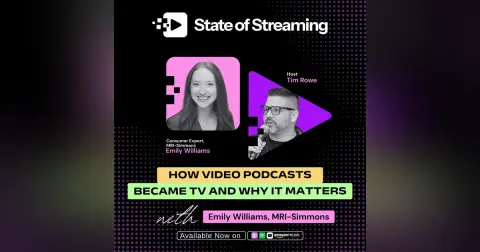
Have a question? Send us a text! 📊 Read the MRI-Simmons Video Podcast Report: mrisimmons.com Tim sits down with Emily Williams, Consumer Expert at MRI-Simmons, for a return visit built around fresh data from their annual podcast study — 10,000 US podcast consumers surveyed, weighted and projected to the total US audience. The topic: why the definition of a podcast is breaking down, why that's actually good news, and what the numbers say about where streaming, podcasting, and creator content a...
Key Takeaways
- Only 36% of podcast consumers still define a podcast as audio-only, down from over 60% in 2021, showing a massive shift toward format-agnostic definitions.
- Video is an enhancement rather than a replacement for audio, with 74% of podcast consumers viewing video as an add-on and 53% admitting they often ignore the video to just listen.
- Social media clips officially surpassed word-of-mouth recommendations in 2024 as the number one discovery mechanism for podcasts, accounting for 44% of new show discovery.
- Podcasts are directly competing with streaming services for viewer attention, with 23 million consumers stating podcast time has replaced video streaming time.
- By 2031, the distinction between podcasts and TV is predicted to dissolve entirely, with the media landscape organizing around scripted versus unscripted content and creator communities.
Have a question? Send us a text!
📊 Read the MRI-Simmons Video Podcast Report: mrisimmons.com
Tim sits down with Emily Williams, Consumer Expert at MRI-Simmons, for a return visit built around fresh data from their annual podcast study — 10,000 US podcast consumers surveyed, weighted and projected to the total US audience. The topic: why the definition of a podcast is breaking down, why that's actually good news, and what the numbers say about where streaming, podcasting, and creator content are all converging.
Only 36% of podcast consumers still define a podcast as audio-only. In 2021, that number was over 60%.
The format-first definition of podcasting is collapsing — and Emily's data shows it happening faster than anyone expected. Today 13% of podcast consumers define a podcast as a video program on an app. Another 8% — roughly 7 million active podcast consumers — say they're not even sure how to define a podcast anymore. Emily's read: podcasting isn't losing its identity. It's becoming bigger than the format that originally created it.
- 1:26 – How MRI-Simmons surveys 10,000 US podcast consumers annually and what the study measures
- 3:00 – How the definition of a podcast has shifted: from audio-first to format-agnostic
- 4:47 – The 8% who actively consume podcasts but can't define what they're consuming
96% of podcast consumers still listen to audio. 89% watch video. Video isn't replacing audio — it's adding to it.
The winner-versus-loser framing the industry keeps reaching for doesn't match the data. Nearly three-quarters of podcast consumers — 74% — say video is an enhancement to audio, not a replacement. Two-thirds say they prefer to watch video when it's offered. And 53% say that when they're watching a video podcast, they ignore the video and just listen anyway. The availability of video matters more to consumers than the constant visual attention. They want the option. They don't always use it.
- 9:00 – Why video and audio are complementary formats, not competing ones
- 10:20 – Why 53% of video podcast viewers ignore the video while listening
- 11:30 – The multi-platform consumer: TV at home, audio in the car, clip on Instagram at night
Social media clips have officially replaced word of mouth as the #1 way people discover podcasts.
Up until 2024, the number one podcast discovery mechanism was a friend or colleague recommending a show. Starting in 2024, social media surpassed verbal recommendations. Today 44% of podcast consumers discover shows through social media — ahead of recommendations, app directories, online searches, and advertising. A two-hour episode generates dozens of short clips. Those clips circulate on TikTok, YouTube, and Instagram. The show finds the consumer before the consumer finds the show.
- 18:07 – How social media surpassed word of mouth as the #1 podcast discovery channel in 2024
- 18:30 – Why video creates the short-clip discovery engine that audio alone never could
- 19:45 – Why consumers discover the clip before they discover the podcast — and why that's lower friction
23 million consumers say podcast time is replacing streaming time. Netflix is paying attention.
Podcasts are not just another content category for streaming platforms — they are increasingly a competitor for the same hours. 23 million consumers say their podcast time is replacing video streaming. Another 32 million say it's replacing traditional live TV. Nearly 60% of podcast consumers say they find podcasts more engaging than TV. And 70% say they actively seek out other content from publishers once they find a program they like — TV shows, movies, live events, merchandise. That's not passive media consumption. That's fandom. That's why Netflix and YouTube are in a bidding war for creator franchises.
- 12:54 – Why streaming platforms see podcasts as a competitor for attention, not just a content category
- 13:30 – Why 55% of podcast consumers — about 50 million people — go to YouTube for podcasts
- 16:21 – Why streaming services acquiring podcasts are buying loyal audiences, trusted creators, and communities
By 2031, we'll stop asking whether something is a podcast or a TV show. We'll just ask whether it has an audience.
Emily's five-year prediction: the podcast-versus-TV distinction disappears. The relevant distinction becomes scripted versus unscripted. The future media landscape will be organized around creators, communities, and interests — not formats. Brands that create belonging and give audiences reasons to return will win. The format will be irrelevant.
- 21:19 – Emily's 2031 prediction: the end of the podcast-versus-TV conversation
- 21:45 – Why scripted vs. unscripted is the distinction that actually matters to consumers
- 22:10 – Why the future asks "does it have an audience?" not "is it a podcast or a TV show?"
📊 Read the MRI-Simmons Podcast Study highlights deck — free: mrisimmons.com
Connect with Emily Williams on LinkedIn · MRI-Simmons
Thanks to Looper Insights for sponsoring today’s show! Ready to unlock your streaming strategy edge? Head over to mystreamingvalue.com to compare CTV home screens and find out which spaces are worth the most. You’ll even learn exactly why Fox was willing to pay $22 billion for Roku. Stop guessing and start scaling—visit mystreamingvalue.com to get your free insights today!
Frequently Asked Questions
How do consumers currently define a podcast?
The definition of a podcast has broadened significantly, with only 36% defining it as strictly audio-only. Others view it as creator-led shows, spoken word content on demand, or video programs on apps, while 8% are no longer sure how to define a podcast.
Are video podcasts replacing audio podcasts?
No, video and audio are complementary formats rather than competing ones. 96% of podcast consumers still listen to audio, and 74% view video as an enhancement rather than a replacement.
What is the number one way people discover new podcasts?
As of 2024, social media clips have surpassed word-of-mouth recommendations as the primary discovery mechanism, with 44% of podcast consumers finding new shows through social platforms like TikTok, Instagram, and YouTube.
Why are major streaming platforms acquiring podcasts?
Streaming platforms see podcasts as direct competitors for consumer attention and are acquiring them to secure loyal audiences, trusted creators, and passionate communities that extend into multi-format fandoms.
00:00 - The Surprising New Podcast Stats
01:36 - Why Defining Podcasts Gets Messy
03:44 - Podcasting Shifts From Format To Hosts
09:34 - Video Enhances Audio Not Replaces
13:07 - Why Streamers Are Buying Podcasts
18:51 - Social Clips Replace Word Of Mouth
21:39 - 2031 Predictions For Media Categories
23:36 - Where To Get The Research Deck
24:44 - Final Takeaways And Share Request
The Surprising New Podcast Stats
Tim Rowe, HostDid you know that only 36% of podcast listeners still define a podcast as audio only? So why are more than half of video podcast viewers ignoring the video while the episode plays? And why are streaming platforms doubling down on podcasts? Emily Williams from MRI-Simmons returns to the podcast here to share fresh data on how video podcasting is blurring the lines between digital creators and traditional television. We discussed why social media clips have officially replaced word of mouth for show discovery and why major streaming services are bidding big for the top podcast franchises. Be sure to subscribe to the show so you stay ahead of consumer media trends. Now let's dive into the conversation.
Why Defining Podcasts Gets Messy
Tim Rowe, HostEmily Williams, welcome back to this State of Streaming Podcast. We're going to be talking about actually this format, we're going to be talking about video podcasting and how it's kind of transcended or even further blurred the lines between what is TV and what is everything else. Welcome back to the podcast.
Emily Williams, Consumer Expert at MRI-SimmonsThank you so much for having me. It's very meta to talk video podcasts on a video podcast. I like it.
Tim Rowe, HostSo meta. So maybe take us through how does MRI-Simmons define what a podcast is?
Emily Williams, Consumer Expert at MRI-SimmonsOh, goodness. Okay. Well, MRI-Simmons is one of the leading consumer insights companies in the US. And we are helping brands and agencies and media companies understand the American consumer through a nationally representative single source view of attitudes, behaviors, media consumption, including podcast consumption, and purchasing habits. And our goal is really to help marketers move beyond impressions and exposures to understand who they're reaching and what people care about, what they buy, and how their behaviors kind of connect across the media landscape. And my role is on our research team, where I lead many of our syndicated consumer studies called focus studies that dive deeper into specific areas, one of those areas being podcasts. So we have a podcast study that surveys about 10,000 US podcast consumers each year. And their raw data gets weighted and projected up to total podcast consumers in the US. And this study, which is my personal favorite that I work on, it explores how consumers discover and engage with podcast content, which is across platforms, genres, devices, while also uncovering the motivations and behaviors that drive their listening and advertising impact. So we have a ton of data that I'm excited to talk about today, but you asked the, you know, the definition of a podcast. Honestly, I think based on our research, the definition of a podcast is breaking down. But I don't think that's a bad thing.
Podcasting Shifts From Format To Hosts
Emily Williams, Consumer Expert at MRI-SimmonsIn fact, I think it's a sign that the medium is maturing. In our podcast study, we actually track how the 90 million US podcast consumers define what a podcast is. And that definition has shifted. Yeah, we asked them, like, how do you how do you think about a podcast? And if you go back like 10 or 15 years, you know, the definition was pretty straightforward. It was an audiophile distributed through an RSS feed that you listen to on your phone or your computer. The format itself was central to how people understood what a podcast is. Today, however, that's no longer the case. So when we ask consumers how they define a podcast, 23% said it's strictly an audio program. And another about 13% think of them as any audio content that isn't traditional radio. So combined, only 36% of podcast consumers still define podcasts as an audio only medium. Looking back at our data set to 2021, that same number was over 60%. So just in five years, the definition of a podcast has shifted drastically from being audio first.
Tim Rowe, HostIt's huge.
Emily Williams, Consumer Expert at MRI-SimmonsI know it is. So so you know, we kind of we broke it down a little bit further. We're like, okay, today, so 36% define podcasts as strictly audio. Meanwhile, 15% define a podcast as any creator-led show that they can find online, whether it's audio or video. Another 14% say that it's simply any spoken word content available on demand. And 13% actually define podcasts as video programs on an app. So they have flipped completely away from the audio definition.
Tim Rowe, HostWow.
Emily Williams, Consumer Expert at MRI-SimmonsYeah.
Tim Rowe, HostI think that we'd all be shocked by those answers.
Emily Williams, Consumer Expert at MRI-SimmonsAbsolutely. Yeah. I mean, the podcasts traditionally were audio and have been, but recently, especially in the past five years, that that is becoming no more. And what's really interesting is that another about 14% don't seem to care about the format at all. To them, they say like a podcast is simply content that is labeled a podcast, whether it's audio, video, something in between, like they don't really consider the format when they're thinking of it. They're really just caring how it's being marketed or how they're able to find it on their apps, which is a completely different perspective. And then there's perhaps my favorite finding, which is the remainder of people. This year, 8% of podcast consumers told us that they're not even sure how to define a podcast anymore. So we're talking about 7 million people who actively consume podcasts, but they can't clearly articulate what the category is. And to me, that's a sign that podcasting is moving beyond a format.
Tim Rowe, HostIs it an opportunity or is that a problem?
Emily Williams, Consumer Expert at MRI-SimmonsI think it's an opportunity. I mean, I think podcasts, what's kind of driving this is that podcasts have become something much more relationship-driven. So consumers are not following distribution technologies. They're following hosts. You know, they're following Joe Rogan and Mel Robbins and Alex Cooper and Tim Rowe. You know, they're they're following.
Tim Rowe, HostYou know, that's a good reminder, Emily. We're going to take a quick time out. If you're listening right now, but you haven't yet subscribed, make sure to do that. Make sure to subscribe and follow the podcast wherever you're listening.
Emily Williams, Consumer Expert at MRI-SimmonsThere we go. Nice.
Tim Rowe, HostThank you for the setup.
Emily Williams, Consumer Expert at MRI-SimmonsNice plug. Nice plug. But yeah, so consumers, they're following personalities and expertise. And when that happens, I think the technical definition becomes less important. I actually think podcasting is following the same path that television did. So there was a time when people really cared about whether a show was on broadcast or cable or a premium channel or specific streaming service. But eventually consumers stopped caring about the delivery mechanism and they just started caring about the content itself. And we actually talked about this in our last episode that I was a guest on. People will go wherever the content is that they want to watch. And I think podcasting is headed in that same direction. Consumers are less concerned about is this technically a podcast or is this an audio, like a specific location or time that I need to be listening to this? Instead, they're saying, do I like this creator? Is this content valuable? Do I want to spend time with this host? So if the definition of a podcast is breaking down, I don't think it's because podcasting is losing its identity. I think it's because it's becoming bigger than the format that originally created it.
Tim Rowe, HostIt's really interesting. I'll share an anecdote. Just as a as a podcaster, as a creator, I started podcasting back in 2019, which is almost seven years ago. And at the time, it was really that. It was the ability to have access as a creator to create and share the conversations that I wanted to. And it was just that. The barrier to entry was so low that anyone could get involved. Now, today, fast forward seven years, the thing that I'm actually thinking about the most is the production. How do we package the content? How do we make it as easy to find as possible for the audience? It's interesting, even just thinking about how the last seven years as a podcaster has changed significantly to kind of meet and match some of the consumer demand. We see it on the back end, we see video becoming a huge mechanism. It's a huge way that folks consume this podcast, even on YouTube, on Apple, on Spotify. What are you seeing in terms of video consumption across those platforms?
Video Enhances Audio Not Replaces
Tim Rowe, HostSo we know that the definition is blurred, it's video, it's audio. What what are you hearing from folks when they talk about video podcasting?
Emily Williams, Consumer Expert at MRI-SimmonsI think obviously there's there's tension in the industry and even like like we just discussed, confusion with the consumer. I think whenever a new format emerges, the industry tends to frame it as like a winner versus loser story, right? So, like, is streaming replacing linear? Is social replacing TV? But now the question is like, is video replacing audio? And that's not really what the data is telling us. In our podcast study, we find that 96% of podcast consumers still listen to audio podcasts. That's nearly universal. At the same time, 89% watch video podcasts. So if video were truly replacing audio, I wouldn't expect those numbers to be so close. And I would expect that 96% to be going down, and it's not. So what we're seeing instead is that consumers are embracing both formats. They're using each format in different situations. In fact, we ask consumers directly if video podcasts are replacing audio for them. And nearly three-quarters, about 74%, agree that video formats are an enhancement to audio, not a replacement. So that's a pretty clear signal from audiences themselves. They're saying, like, I like having video, but I don't want to lose audio. I want that too. So they want flexibility more than they want one format over the other. And we find that when consumers are considering to start a new podcast, two-thirds say it's important that both the audio and video versions are available. So they want options. We also found that two-thirds say that they would prefer to watch the video if it's offered. So at first glance, you might think, well, there it is, like video wins. They prefer video. But then you get to like an incredibly relatable finding, which is that 53% say that when they're watching a video podcast, they usually ignore the video and just listen to the audio anyway. So more than half of these people are watching something that they're not consistently watching, just like with TV. You know, you have a show on in the background while you're doing something else. They're doing the same thing with video podcasts. And what that tells me is that consumers value the availability of video more than the constant visual attention. They like having the option. They might glance up when a guest makes a funny face or when someone pulls up a chart or, you know, someone, you know, some interesting moment happens. But the conversation itself remains the core product. And I think that's why podcasts have become incredibly format flexible. A consumer might start watching a podcast on their TV at home, switch to audio while driving to work, and then catch a clip on Instagram later that night. So, you know, so to kind of address your question of, you know, how are consumers thinking about video and is video replacing audio? I think the future isn't about one format over the other. I think it's about giving consumers the freedom to choose the format that best fits the moment they're in. And the creators and the platforms that make that experience seamless are probably going to be the ones that come out on top.
Tim Rowe, HostProbably no surprise. And it's a theme that I'm picking up on from this conversation from our last conversation. We want choice.
Emily Williams, Consumer Expert at MRI-SimmonsWe want choice.
Tim Rowe, HostWe want to have our cake and we want to eat it too. We want infinite cake.
Emily Williams, Consumer Expert at MRI-SimmonsAll the cake, all the choice, all the flavors, all the flavors of
Why Streamers Are Buying Podcasts
Emily Williams, Consumer Expert at MRI-Simmonscake.
Tim Rowe, HostSo let's be a little bit, let's be tactical here. Let's think maybe from the the streaming business decision making side of the equation. Should streaming services be treating podcasts as streaming content? Why do you think we see Netflix going after podcasters? Now YouTube is digging in and saying, hey, we're gonna pay creators to not even talk to Netflix. It's kind of getting it's getting a little key heated in there. How should streamers be thinking about this?
Emily Williams, Consumer Expert at MRI-SimmonsWell, I it's interesting because like I said, 89% of podcast consumers are watching video podcasts. So that's that's roughly 80 million Americans. And 92% say that they plan to watch video either the same amount or more over the next year. So they're they're telling us this behavior isn't going away anytime soon. And a main reason I think streaming companies are paying attention right now is because podcasts are increasingly competing for share of time. This year we found that about 23 million consumers say the time they spend with podcasts is replacing time they would have spent on video streaming services. And another 32 million say podcasts are replacing traditional live TV. So, you know, if you're a Netflix or a Hulu or any streaming platform, podcasts aren't just another content category. They are increasingly another competitor for the audience's attention. And diving further is why people are spending more time with podcasts. This year, nearly 60% of podcast consumers told us that they find podcasts more engaging than TV. And even more, the same percentage said that they are more captivated by podcasts than other forms of media in general. So for decades, you know, TV was considered the most engaging form of entertainment. Yet today, most podcast consumers specifically are telling us that long form conversations, creator-led content, and verbal storytelling are actually holding their attention better than TV. Then you have the platform story. And right now, obviously, there's one company that you mentioned that's impossible to ignore, and that's YouTube. We see about 55% of podcast consumers go to YouTube for podcasts today. It's about 50 million people. And just four years ago, that number was coming in at about 38%. So we've seen enormous growth in a relatively short period of time for that one platform. What's cool is that YouTube was already a major podcast platform before video became a thing because people were uploading static images with audio files and building audiences there years ago. So the rise of video has only strengthened YouTube's position because it plays directly into what YouTube does best, and that's discovery, sharing, and creator content, as you mentioned. So the rest of the streaming industry is seeing this happening and they see audiences spending meaningful amounts of time with podcasts on YouTube. And naturally they're asking themselves whether they need a stronger strategy of their own. But I think maybe the strongest reason that streaming companies are acquiring podcasts or creating their own isn't just because they want podcast content, it's because they want creator franchises. We talk a lot in the media industry about intellectual property, but 70% of podcast consumers tell us they actively seek out other content from publishers when they find a program they like. 70% would watch a TV show or a movie based on their favorite podcast. Nearly two-thirds would attend a live event hosted by their favorite podcasters, and over half would buy merch from their favorite programs. So that's not passive media consumption. That's fandom.
Tim Rowe, HostIt really is.
Emily Williams, Consumer Expert at MRI-SimmonsYeah. So I think that when streaming services acquire podcasts, they're buying a loyal audience, a trusted creator, and a community. And increasingly, they're buying a brand that can live across multiple formats and revenue streams.
Tim Rowe, HostSo much of what you're describing, so much of the footprint, so much of the consumer interest, it's being led by creators who could be doing this from their home with a pretty basic setup, or not that much of an investment, not studios, not teams of writers and producers, and and kind of traditionally what's been associated with creating content, if you will. And to your point, this is a battle for attention. There's a finite number of people and a finite number of hours that we can spend listening or watching content, and creators are winning across the board. It's not just that YouTube is great at discoverability, it's that they're great at discoverability and they're the home of the content that consumers are ultimately looking for. You had mentioned something interesting in a previous conversation that we had about the incrementality of a platform adding a huge podcast. I think we were talking about Netflix and some of the creators that they've added. And hey, it's adding these huge swaths of audience, but is that good for the IP? Is that good for the creator ultimately? Do you have any insights about incremental audience and are we adding new audiences? What's the what's the net impact? Are we growing?
Emily Williams, Consumer Expert at MRI-SimmonsI think yes. I think video podcasts are helping consumers discover content in a way that we haven't seen podcast growth. So our research actually suggests that the discovery process
Social Clips Replace Word Of Mouth
Emily Williams, Consumer Expert at MRI-Simmonsfor podcasts has fundamentally changed over the past few years. So up until 2024, the number one way people discovered podcasts was through word of mouth. So a friend, a family member, a coworker, someone you know would recommend a show and then you would check it out. Today that is no longer true. Starting in 2024, social media surpassed verbal recommendations in ways people discover new podcast programs. And today, 44% of podcast consumers discover their programs through social media, ahead of recommendations, online searches, app directories, advertising, et cetera. In other words, social media clips have become the new podcast discovery engine. And honestly, that's where video podcasts have had such a huge impact because video creates highly shareable content. You know, a two-hour podcast might generate dozens of short clips. Maybe it's a funny moment or a good story from a guest. And those clips start circulating on TikTok and YouTube and Instagram. And a dozen moments multiply by the number of times it's shared, and then multiply that by the thousands of podcasts that are producing video content every day. And suddenly you have millions of podcast clips being delivered to consumers across their social feeds. And many consumers, you know, they discover the clip before they discover the podcast. So they're not searching for the show, the show finds them. And I think that's a much lower friction experience than the old model. You know, like instead of asking someone to commit to listening to an hour-long episode of a show they've never heard of, you're letting them sample 60 seconds. It's like a trailer recommendation and a product demo all rolled into one. And what's interesting is that the clip often highlights the exact things that consumers tell us they care about when they're choosing a new program. When we ask podcast consumers what matters most when choosing a new program, the top factors are the host, the genre, and the production quality of the show. So video happens to showcase all three of those very well. You know, a charismatic host will attract attention, a compelling guest will spark curiosity, and then high production quality will stand out visually, of course. All that combined, the content has a much higher chance of generating millions of views across social platforms. And of course, you know, the goal isn't necessarily to keep consuming short clips forever. The clips are meant to be a gateway. And, you know, once consumers are hooked, many of them do seek out the content to find the full episode. Some people will find it on video, some people will switch over to audio because it better fits into their daily routine. So I think video podcasts are actually helping solve the industry's challenge of discovery.
2031 Predictions For Media Categories
Tim Rowe, HostAll right. If we fast forward five years from now, it's 2026 right now. If we hop in our time machine, we zip forward to 2031. Where do you think we land on the conversation about podcasting and streaming? Are we even are we even talking about podcasts as podcasts? Is it all just streaming? What do you think we see in 2031?
Emily Williams, Consumer Expert at MRI-SimmonsHonestly, I don't think five years from now we'll be having separate conversations the way we do today. I think we will look back and realize that we were focused on the wrong distinction of podcasts versus TV. We've talked about how the definition of a podcast is becoming more fluid, video is complementing rather than replacing audio, and consumers are increasingly following creators across platforms and formats. And to me, all of those point to the same larger trend that consumers care less about how content is delivered and more about why they're consuming it. I think in five years, we'll spend less time debating podcasts versus television and more time talking about scripted versus unscripted content. I think that's a distinction consumers seem to understand. You know, sometimes they want a premium scripted drama, other times they want a conversation or commentary or advice. And those choices are becoming more meaningful than whether the content technically is a podcast or a TV show or something else. And so I say the future media landscape will be organized around like communities and creators and interests much more than formats. And brands will need to create belonging and give audiences reasons to come back over and over again. Because at the end of the day, consumers are looking for content and communities that matter to them. And that's why I think we'll stop asking whether something is a podcast or a TV talk show and we'll simply ask whether it has an audience.
Where To Get The Research Deck
Tim Rowe, HostWe're going to offer a sample of the data that you've you've teased us with here today. If folks want to learn more about MRI-Simmons, get in touch with yourself, where do they go? We're going to make that sample very easy to find. It's going to be linked right at the top of the show notes. We'll link to it in all of the socials. It'll be easy to find along with this podcast. But if folks want to connect with you, Emily, learn more about MRI-Simmons, where do they go?
Emily Williams, Consumer Expert at MRI-SimmonsYeah, follow MRI-Simmons on LinkedIn or visit mrisimmons.com to follow our blog page. I'm constantly putting out new content on podcasting as well as TV, politics, retail, health, a variety of other topics. But yes, I definitely want to offer that link to what is our podcast study highlights deck. It contains some of the information I talked about today and more. It's a free teaser of the full study report that covers everything that we measure in the podcast study. So if listeners are interested in buying the full report, you please reach out. But the download is free and it shares some more nuggets from our research this year.
Tim Rowe, HostExcellent. That will be easy to find. It will be close by. Emily, thanks so much for being here.
Emily Williams, Consumer Expert at MRI-SimmonsThank you so much for having me.
Tim Rowe, HostAbsolutely.
Final Takeaways And Share Request
Tim Rowe, HostAnd if you found this conversation to be helpful, please share it with a colleague or client. Start a conversation yourself today. We'll see y'all next time.