


 Spotify

 Apple Podcasts

 YouTube

 iHeartRadio
Why Football Still Owns Television and How Shoulder Content Is Shifting CPMs | Ross Benes, Senior Analyst at EMARKETER
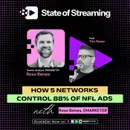
Have a question? Send us a text! Tim sits down with Ross Benes from EMARKETER to map out the current landscape of U.S. football advertising — and why traditional broadcasters are still dominating the space despite the streaming boom. Recorded in peak football season to break down Ross's latest U.S. football advertising report. Linear networks still control 88% of the ad revenue, and college football is becoming a mini NFL. While streaming dominates headlines, 88% of NFL ad revenue still...
Key Takeaways
- Traditional broadcast and linear networks still dominate U.S. football advertising, capturing 88% of total NFL ad revenue across five legacy companies: Fox, Paramount, Comcast, Disney, and the NFL Network.
- College football is increasingly mirroring the professional model through massive media rights deals, conference realignments, and an expanded 24-team playoff, effectively becoming a lucrative mini NFL.
- Streaming pure-plays like Amazon and Netflix control the remaining 12% of NFL ad inventory, utilizing distinct strategies such as Amazon's consistent weekly presence on Thursday Night Football and Netflix's one-off event viewing like Christmas games.
- A massive influx of connected TV shoulder content, including docuseries and spin-offs, has increased ad supply and caused live football CTV eCPMs to drop by 13%.
- Despite dropping CPMs for shoulder content, the Super Bowl remains immune to dilution, on track to become the first billion-dollar ad-spend Super Bowl with Disney selling out inventory early at record-high asking prices and introducing hyper-segmented alt-casts.
Have a question? Send us a text!
Get the report from this episode here
Tim sits down with Ross Benes from EMARKETER to map out the current landscape of U.S. football advertising — and why traditional broadcasters are still dominating the space despite the streaming boom. Recorded in peak football season to break down Ross's latest U.S. football advertising report.
Linear networks still control 88% of the ad revenue, and college football is becoming a mini NFL.
While streaming dominates headlines, 88% of NFL ad revenue still flows to five legacy linear companies: Fox, Paramount, Comcast, Disney, and the NFL Network. The lack of local broadcasting flexibility in the NFL keeps the big players firmly in control of the rights. Meanwhile, college football is aggressively mirroring the pro model. With massive media rights deals, rampant conference realignment, and an expanded 24-team playoff, the regional charm of college football is fading as it transforms into a highly lucrative "mini NFL".
- 1:58 – Why linear broadcast networks still capture the lion's share of NFL advertising revenue
- 2:19 – The five legacy companies that control 88% of the NFL ad market
- 3:56 – Conference realignments and why college football is becoming a mini NFL
Streaming's 12% slice and the escalating cost to acquire an NFL viewer.
Amazon and Netflix have carved out the remaining 12% of the NFL advertising market. Amazon's strategy focuses on consistency, successfully turning Thursday Night Football into a reliable brand, whereas Netflix has opted for one-off event viewing like Christmas games. But acquiring these viewers isn't cheap. Networks are paying an average of $4.12 per unique viewer per game, with ESPN and ABC knowingly overpaying to secure indirect benefits like exclusive access and shoulder content partnerships.
- 5:34 – Amazon's strategy for Thursday Night Football versus Netflix's one-off event approach
- 6:12 – The actual cost per unique viewer for NFL games across major networks
- 7:07 – Why ESPN accepts overpaying for NFL rights to fuel their broader content ecosystem
Shoulder content is driving down CPMs, but Super Bowl pricing is hitting record highs.
Connected TV eCPMs against live football actually dropped 13%. The culprit is a massive influx of shoulder content. Spin-offs, docuseries, and reality shows have flooded the market, increasing the ad supply and pushing prices down. Conversely, the Super Bowl remains immune to this dilution and is on pace to be the first billion-dollar ad spend Super Bowl. Disney sold out its inventory before August at a record asking price of $10 million per spot, and is confidently upselling backup advertisers while introducing hyper-segmented alt-casts like a Star Wars feed.
- 7:58 – Why a surge in shoulder content has caused connected TV CPMs to fall 13%
- 9:01 – Shawne Merriman's Lights Out Sports TV and capitalizing on the long tail of football
- 10:04 – Disney's $10 million Super Bowl spots and their strategy of adding targeted alt-casts
Connect with Ross Benes on LinkedIn
Thanks to Looper Insights for sponsoring today’s show! Ready to unlock your streaming strategy edge? Head over to mystreamingvalue.com to compare CTV home screens and find out which spaces are worth the most. You’ll even learn exactly why Fox was willing to pay $22 billion for Roku. Stop guessing and start scaling—visit mystreamingvalue.com to get your free insights today!
Frequently Asked Questions
Why do linear networks still dominate NFL advertising revenue?
Linear networks control 88% of NFL ad revenue because the league's rights are held tightly by major legacy broadcast companies with very little local broadcasting flexibility compared to other sports leagues like the NBA or MLB.
How are Amazon and Netflix approaching NFL streaming rights differently?
Amazon focuses on building consistency by turning Thursday Night Football into a reliable weekly brand, whereas Netflix concentrates on curated, one-off event viewing such as exclusive Christmas games.
Why are connected TV CPMs for live football dropping?
Connected TV eCPMs against live football fell 13% due to a massive surge in shoulder content, such as docuseries and reality spin-offs, which has flooded the market and increased ad supply.
Where can I find the EMARKETER U.S. football advertising report by Ross Benes?
The full report can be accessed by visiting eMarketer Pro and navigating to the sports section.
00:00 - Football Still Owns TV
01:42 - Why Linear Networks Still Dominate
03:55 - College Football Becomes A Mini NFL
05:11 - Amazon And Netflix Take The Rest
06:11 - The Real Cost Of NFL Rights
07:57 - Shoulder Content Pushes CPMs Down
09:37 - Super Bowl Pricing Hits New Highs
10:43 - Where To Get The Report
Football Still Owns TV
Tim Rowe, State of Streaming
Did you know that 92 of the top 100 most watched television events last year were football games? With the NFL and college football dominating the ratings, why are connected TV ad prices for live American football actually dropping? Today I'm joined by Ross Benes from eMarketer to discuss his latest report on US football advertising. We break down why five linear companies still control 88% of all ad revenue and we talk about the two streaming pure play companies that have the other 12%. We talk about how the explosion of shoulder content is actually lowering live football CTV CPMs and why Disney is asking for a record $10 million for a Super Bowl spot and how they sold it out before August. Be sure to subscribe to the podcast for more weekly insights just like this. Now let's get into the conversation.
Why Linear Networks Still Dominate
Tim Rowe, State of Streaming
Ross Benes, welcome back to the State of Streaming podcast.
Ross Benes
Hey, thanks for having me on here, Tim.
Tim Rowe, State of Streaming
You've got a new report out, U.S. football advertising. We are in peak football season. What did you set to uncover through this report?
Ross Benes
You know, I was just trying to get a sense of how advertising in football games is changing as more of it becomes streaming, and if those old ways of buying are still really intact. And one of the things that was surprising to me was just how much revenue still goes to those main linear broadcast networks. They are still the lion's share, and I think they're gonna be for a while.
Tim Rowe, State of Streaming
Yeah, that stood out to me. Five companies accounting for 88% of all NFL ad revenue. Fox comes in with 30%, Paramount, I guess now Skydance uh 23%, Comcast 21%, Disney 12%, and NFL network owned by ESPN, and I guess that's there for Disney at 2%. Did that surprise you?
Ross Benes
Well, a little bit because you hear about all the digital options that are coming and how like you know you don't want to get behind on streaming if you are a sports league. But the rights are, especially in the NFL, the rights are very much held by those linear networks. And I think a big reason why is there's very little local broadcasting. You have some regional, but you know, there there isn't a lot of flexibility in the NFL like there is with the NBA and MLB, where you can have a whole assortment of different people broadcasting one team's games. You're a little more restricted in the NFL just due to the number of games.
Tim Rowe, State of Streaming
Interesting. And if we look back at last year, 96 of the top 100 most watched television events were sports. The four that weren't were the Macy's Thanksgiving Day Parade, the Oscars, Presidential Inauguration, and the State of the Union. 92 of the top 100 most watched television events were football, 84 were the NFL, and eight were college football playoffs. So college football certainly has uh has some skin in the game, and you're wearing a Nebraska shirt there. What's the story about college football in this bigger NFL or bigger football advertising picture?
College Football Becomes A Mini NFL
Ross Benes
Well, the leagues themselves are becoming much more active on securing giant media rights deals, and that's led to all this conference realignment where you got like Rutgers and UCLA in the same conference, or Cal and Miami in the same conference. You just saw this unfold again in the last few weeks where ESPN just paid another huge bonanza to expand the college football playoff. So that there's a huge demand for more college football games, especially at a top level. And now that they're paying players and the playoff has expanded, the uniqueness and some of the regionality that made college football charming and you know really much its own thing is going away a little bit. It's it's a mini NFL with the younger players at this point.
Tim Rowe, State of Streaming
Yeah, that's interesting. We see all the money coming into college sports is definitely changing the landscape of the game, but advertisers are hungry for live sports. So yeah, people are still watching.
Ross Benes
They're not they're not tuning out, even though that's all turning it off. No, not I probably the opposite is happening. I think, especially during the playoffs, you know, they're really, really glued in. I think ESPN actually probably got a good deal on that playoff expansion for a few hundred million dollars. They expanded it all the way to 24 teams, just given how much rights have increased. I think if we look back in five years, we're gonna say that was actually fairly cheap inventory to secure.
Amazon And Netflix Take The Rest
Tim Rowe, State of Streaming
Yeah, that's interesting. On the streaming side, Amazon obviously accounts for the lion's share, that 12 remaining percent. So five companies accounting for 88% of the NFL ad revenue, the other 12% going to Amazon with Thursday Night Football and Netflix with kind of their curated menu of games. Anything stand out to you there?
Ross Benes
Just that Amazon's been the most proactive with NFL, and I would say with NBA, you know, with with the season launching now, they have the consistency that a lot of streaming services lack to turn Thursday night football into a stronger brand than it was before and just own that. It's it's a little different than when you know YouTube gets like a game here, not counting Sunday ticket, like they get like the international game, you know, Netflix will get like the Christmas games or whatever, but it's very one-off. You know, Amazon's strategy, both NBA and NFL, and in various other sports they have is to like consistently appear at least once a week. And I think that helps uh viewers get accustomed.
The Real Cost Of NFL Rights
Tim Rowe, State of Streaming
I want to bring uh a recent analysis up here from one of our syndicated contributors, Michael Beach. He writes a column called The State of the Screens. He's got some great data here about the cost per unique viewer per game, and he's got a breakdown here that shows you what it's actually costing the networks to put eyeballs on a game. We've got CBS leading the pack here, so Paramount $2.91, Netflix at $3.10, Fox $3.20, Amazon $3.89, NBC $3.91, the average $4.12, ESPN and ABC overpaying a little bit there to put uh to put eyeballs on an NFL game. Is there a breaking point to this? It feels like you know the NFL rights are are potentially up for renegotiation next year or in the next two years, rather. Is is there a point in diminishing returns? Can the market just continue to take increases?
Ross Benes
I think it can take a little bit of increases for now. Maybe not the monumental they're seeking. You know, I I know the league would like to double its fees. Maybe that's a little aggressive, but they're definitely going to rise faster than inflation. It's one of the few places where you can get that, you know, really tuned-in, reliable audience and and build your network around it. ESPN overpaying, I think they're they're fine doing that. That that goes back to their Monday night football deal several years ago. Now they're in cahoots with the league. You know, they have the NFL network. Like doing that allowed them to form that partnership that I think is beneficial for all the shoulder content ESPN produces, all the access they get to players and teams. So I think there's indirect benefits for getting that package that go beyond just like I got this number of games for this price.
Shoulder Content Pushes CPMs Down
Tim Rowe, State of Streaming
And that shoulder content, there was a trend that stood out to me, especially for this audience. Connected TV e CPMs fell 13% against live football. Why was that?
Ross Benes
Well, CPMs and and streaming in general have been flat to declining, whether you're talking about like sports or or non-sports, just like a general trend. But I I I think there's just a big uptick in the amount of shoulder content, especially on streaming services. There are so many like little docuseries or almost like reality TV, you know, spin-offs that come out of the league that are tangentially related. And you didn't have as much of that before. So, you know, if you were gonna compare like 10 years ago, you had hard knocks and not much else. And now most of the networks who have a deal with the NFL produce some sort of show about the league that isn't live games, and I think there's just a a little bit of a you know, in the increased ad supply just drives down the prices a little bit.
Tim Rowe, State of Streaming
We caught up with Shawne Merriman, three-time NFL All Pro and founder of Lights Out Sports TV. He was just launching some specific NFL shoulder content that was focused on the fan and tailgating, and and we'll catch up with him on how that's going. But it is interesting to see how streaming has has unlocked kind of this long tail of shoulder content, which now allows you as an advertiser to reach those audiences, perhaps at a discount, with with the same at least relative context to the big game itself.
Ross Benes
But on the I mean Peyton Manning has a whole company built around doing this.
Super Bowl Pricing Hits New Highs
Ross Benes
Tim Rowe, State of Streaming
That's a great point. The the on the other side of it, not CPM s falling, but this Super Bowl on pace to be the first billion dollar ad spend Super Bowl. Roku data, I think you had in there that playoff spots were going for between a million and a half and three million last year. The regular season was between 800k and a million. But Disney did something different this year. What did Disney do?
Ross Benes
Well, Variety reported that Disney sold out their inventory, you know, asking a high price, asking about $10 million per spot. They didn't always get that. But now that they're sold out, they're still going out to market asking for increases in case someone backs out. So they're already upselling on the event that there'd be a new advertiser to slot in. And that's a little bit unusual. I think it shows how confident they are. They keep adding those alt casts, they just added a Star Wars one. There's more ways to segment the Disney audience for this Super Bowl than there is for most Super Bowls, which tend to rely on one or maybe two feeds.
Tim Rowe, State of Streaming
It's really interesting. It's certainly a trend to watch.
Where To Get The Report
Tim Rowe, State of Streaming
Ross, if folks want to get the full report, where should they go?
Ross Benes
They can just go to eMarketer Pro and click on the sports section and they'll find it. Or we'll put a link on your website.
Tim Rowe, State of Streaming
We will make it easy to find. It'll be linked nearby. There's a lot in here. We talked about some of it today, But get the whole report, go deep on this. Ross, what are you working on next? What are you most excited about?
Ross Benes
Well, I got a lot of year-end trends reports to do. So when we get close to the new year, we got to figure out like what's the the next big thing and kind of be a futurist a little bit. And I don't have that entirely nailed down yet, but it is a thing I'm excited to work on.
Tim Rowe, State of Streaming
All right. We're excited to catch up with you about it. Ross Benes, thank you so much for joining the State of Streaming podcast.
Ross Benes
Hey, good to be here.
Tim Rowe, State of Streaming
Absolutely. And if you found this conversation to be helpful, please share it with a colleague or a client and start a conversation yourself today. We'll see y'all next time.